Tuesday, November 1, 2011

Please Don't Go

Title: Please Don't Go
Author: John Hartson
Published: 2011
Publisher: Mainstream

There are some footballers, who for whatever reason, we cannot help but like, such is their enthusiasm and joy they have for their sport – Lionel Messi and Paul Gascoigne are two that immediately spring to mind. As does the larger than life John Hartson.

Hartson has previously written an autobiography in 2007 (before he retired as is becoming de riguer thesedays) but in 2010 he took on a bigger challenge than any he faced on the pitch – testicular cancer. Please Don’t Go details Hartson’s life in the months leading up to his hospitalisation and the months after. He deals with the majority of his footballing career in flashbacks – his time at Luton, Arsenal, West Ham and Wimbledon dealt with fairly swiftly. He also reflects on life growing up in Wales and some of the behaviour in his teenage years that impacted upon his happiness later in life.

Hartson is unflinchingly honest about all things in this book. He talks about money freely as well as the material items in life although it is done in a matter-of-fact style as opposed to flaunting his wealth. Yet Hartson should be richer than he is: a series of big transfer fees combined with hefty pay packets that were squandered on bets as well as a substantial divorce settlement means that Hartson isn’t uncomfortable but should be in a better position. He’s cavalier with his money but also acutely aware of it too. His divorce and the misery it caused him is also dealt with openly – arguably it’s not in Hartson’s nature to be anything else.

Like Tony Cascarino’s Full Time, Please Don’t Go reveals the frustration of a player in the twilight of their career – the body aches, the enthusiasm for the game dissipates and crucially other things in life start to matter more than football. And in Hartson’s case it is the damage caused by breakdown of his previous marriage and separation from his children. Hartson’s love of his family, his children and partner Sarah shines through the entirety of this book – he has a lot of love to give and this reciprocated by friends and family. Hartson also explores some of the problems that face many footballers: gambling as well as others such as depression and over-eating which is as a consequence of the lack of fulfilment he is receiving in his career.

All this is intriguing but there is a sense of perpetual creeping doom which is inescapable when the reader knows what is about to happen to Hartson. How close Hartson came to death is recalled in lucid and simple prose by his sister and Sarah as Hartson had lost consciousness for several weeks. This is undeniably dramatic but not gripping as the reader knows that ultimately there is a happy ending to this story.

While Please Don’t Go may be relatively weak in its writing, that is made up for in the strength of the story being told negates this. John Hartson is responsible for one of the most honest autobiographies in years and for that we should be thankful.


Buy Please Don't Go here.

Monday, October 31, 2011

Football - Bloody Hell!

Title: Football - Bloody Hell!
Author: Patrick Barclay
Published: 2011 (Paperback)
Publisher: Yellow Jersey


There exists a litany of books about Sir Alex Ferguson – from Michael Crick’s The Boss to This Is The One by Daniel Taylor and Frank Worrall’s Walking in A Fergie Wonderland as well as several more including his own autobiography which was published in 1999 following his triumph in Barcelona over Bayern Munich. Does Patrick Barclay’s book bring about any sensational revelations or scandals? No, but it presents an even-handed and well crafted look at arguably the game’s greatest boss.

Football – Bloody Hell! tells the story of Ferguson’s life from his humble beginnings in Govan to his long tenure at Old Trafford via a steady if unspectacular playing career and managerial stints at East Stirlingshire, St Mirren, Aberdeen and Scotland (the latter in only a caretaker role). The recently released paperback edition includes chapters charting the tumultuous 2010-11 season which saw Manchester United clinch a record-breaking 19th league title and a Champions League runners-up berth but also the rise of the ‘noisy neighbours’ in the newly minted Manchester City and the strange case of Wayne Rooney’s poor performances, transfer request and subsequent return to form.

Barclay is an elegant writer which allows Football – Bloody Hell! to flow, making it a very easy read. Barclay is also helped by spending many of his years in the company of Ferguson (the book contains a photo of Barclay along with the European Cup Winners Cup and a svelte looking Gerry McNee on the plane home from triumph over Real Madrid in Gothenburg). Barclay is clearly an admirer of Ferguson’s talents but is also keenly aware of the more unpleasant sides of Ferguson’s character. Barclay regales us with a tale of the torrent of abuse he received from Ferguson after Barclay hinted that Ferguson may have been losing control at Old Trafford. Another feature is what Sir Alex may call taking a stand but others may regard as pettiness: his boycott of the BBC after a Panorama investigation questioning the role of his son Jason in some of Manchester United’s transfer dealings as well as recalling several players who were on loan to Preston North End days after another of his sons, Darren, was sacked by the club.

Barclay has obviously a good book of contacts and many of these men offer key insights into Ferguson’s psyche. Those thinking footballers, Mark McGhee and Gordon Strachan reveal a great deal and give good assessments about what makes him tick despite both of their relationships with Ferguson breaking down. Aside from a detour chapter detailing McGhee’s management record which is unnecessary the book keeps a good pace, however it is noticeable that the chapters from 2008 onwards feel rushed and lack the same detail as those that preceded it. Perhaps this is not surprising as they ultimately suffer from a lack of insight from those closest to Sir Alex Ferguson. Unlike previous chapters, many of those who have stories to tell are no doubt still receiving the benefits of Sir Alex’s patronage – and as Jaap Stam discovered – speaking publically about the boss is akin to signing your own death warrant at Old Trafford.

Ultimately a man who has managed to achieve greatness and continued success as Ferguson deserves a fitting biography and Football – Bloody Hell! delivers that – though nothing is certain in football, it’ll be more than likely that Barclay will be making further additions to future editions of this book.


Buy Football - Bloody Hell! here.

Wednesday, September 7, 2011

Trautmann's Journey

Title: Trautmann's Journey: From Hitler Youth to FA Cup Legend
Author: Catrine Clay
Published: 2010
Publisher: Yellow Jersey

There aren’t many footballers biographies where you can be over half-way through and 200 pages in before the player even begins to have a lifestyle closely approximating that of a professional footballer. But Bert Trautmann is no ordinary footballer as this book by Catrine Clay reveals.

Many people will know Trautmann as the German Manchester City goalkeeper who broke his neck in the 1955 FA Cup Final with sixteen minutes to play yet determined to continue, played on, making a number of important saves to ensure his side clinched the cup. Yet ten years previously he was fighting for Germany in the Second World War against many of the players and fans who would later applaud and cheer him on.

Born in Bremen, Trautmann was the right age to be fully indoctrinated by the plans of the Nazi Party and from a young age, Bert was a member of the Hitler Youth – an organisation that valued athleticism and brawn above thinking ability. Whilst Trautmann has some of the latter, he was a gifted handball and football player and was welcomed by the Hitler Youth and a model Aryan. Unsurprisingly, his academic studies took a back seat when he continually being lauded with praise and upheld as a good example to his peers.

The majority of Trautmann’s Journey focuses on Bert’s life from his school days to his time as a Paratrooper in the German Army during the war. Clay makes no excuses here for Trautmann, he was a fully signed up member, who may have been naive about what jobs he was undertaking, nonetheless, was fully committed to Nazi ideas and was determined to do his bit for the Fuhrer.

Clay vividly paints a picture of what life was like for German soldiers during the War: the futility of trying to beat the Russians and then re-treating to defend Germany’s interests on the Western Front. At the same time, Clay sets the context with description of life for everyday Germans juxtaposed with the internal battles that were occurring between Hitler and his Generals.

Once captured by the British, Trautmann is interned in the north west of England where he is far from repentant about the German actions in the war. However, over time he becomes more aware of the destruction caused by Hitler’s plans, coupled with the warm hospitality he receives from the majority of the Brits he meets, Trautmann decides to stay in England instead of returning to Bremen to be with his family.

The last few chapters of Trautmann’s journey feels rushed with only one devoted to his time at St Helens Town FC and only another with his entire career at Manchester City, where he did a great deal to enhance the reputation of Germans as well as heroically putting his team above danger to himself. Whilst a match by match analysis wouldn’t have been necessary, these chapters feel hurried. The epilogue which recounts Clay speaking to Trautmann is very interesting and definitely more depth would have enhanced the book as much of Bert’s personal life is glossed over in a number of sentences, where certain issues could have been probed more deeply.

There is unlikely to be a footballer who has led such a remarkable life as Bert Trautmann. His story is one that is worth retelling and in this day and age, remarkable that it hasn’t been made into a television series or film. From gifted youth in trouble to FA Cup hero, it’s a tale that’s straight out of Hollywood.


Buy Trautmann's Journey here.

Thursday, July 28, 2011

Believe in the Sign

Title: Believe in the Sign

Author: Mark Hodkinson

Published: 2007

Publisher: Pomona Press

Whilst reading about a perennially small team in the industrial north west of England during the 1970s may not be the glamour that appeals to many sports fans, Mark Hodkinson’s Believe in the Sign is an interesting tale of growing up in Rochdale as well as charting the downright misery of supporting a club that has no history of achieving greatness, isn’t achieving greatness and nor is there any indication they are ever likely to achieve greatness.

Alongside tales of early cup exits to non-league opponents and promises of a ‘fresh start’ under new management, is anecdotes and recollections of adolescence in an unfashionable former-industrial town - the opening of an ASDA supermarket, bikes being stolen, Scout groups and rather grimly, an abduction and murder of a young girl.

There is no flashiness involved in Hodkinson’s book - it is deliberately vacant of some details and it is much the better for it. It is full of smart observations without being pleased with itself. Hodkinson is a writer whose work I will be further investigating (hopefully) in this blog in the future.

Buy Believe in the Sign here.

The Golden Years

Title: The Golden Years - Hibernian in the Days of the Famous Five
Author: Tom Wright
Published: 2010
Publisher: DB Publishing

The Golden Years is the history of Hibernian’s success in the years following the Second World War. Led by a quintet of talented players - Gordon Smith, Lawrie Reilly, Bobby Johnstone, Eddie Turnbull and Willie Ormond. They were known as the Famous Five and for a decade wrestled for dominance as one of the top club sides in Britain, if not the world.

The book is told in standard linear fashion and begins before the outbreak of the Second World War. The style is informative and factual, almost textbook like, not necessarily aimed at entertaining the read. This is a piece of historic preservation rather than an examination of the personalities involved and whilst there is certainly not glaring faults with this style, it does treat the piece rather earnestly rather than celebrate the time with added colour. Another criticism would be the size of the print which is far too small and makes the task of reading the Golden Years far more daunting than it should be.

Wright is the Hibs club historian and it shows. He has access to reams of sources and it’s clear as all the detail is in the book very precisely. There are as well a good few anecdotes which are worth sharing, which certainly date the era: for example in 1949 the Hibs players gave the Board of Directors a Christmas gift. Not a move that I can imagine is replicated in the current era by players at Easter Road (or most clubs for that matter). Also, more tellingly, it emerges that Scotland took 41 people to the World Cup finals in 1954 in Switzerland. Only 13 of them were players. So it appears mismanagement and incompetence has been a fundamental part of the SFA for a prolonged period of time.

What is all the more remarkable about Hibs’ achievements on the pitch during the Famous Five era is that for a side that won the league three times between 1948 and 1952 is that the Famous Five only appeared together in 80 league matches. It is purely conjecture but one would have to wonder what could have been achieved by this Hibernian side if they had stayed injury free.

Buy The Golden Years here.

Thursday, July 14, 2011

Feeding The Monster


Title: Feeding The Monster: How Money, Smarts, and Nerve Took a Team to the Top

Author: Seth Mnookin

Published: 2007

Publisher: Simon & Schuster

Rarely these days do owners and managers of professional sports teams grant a level of access as John Henry, the owner of the Boston Red Sox afforded Seth Mnookin in Feeding The Monster. Mnookin was given access all areas for this book which meant he was fully immersed in the ball club - spending mornings with General Manager Theo Epstein and his Baseball Operations team, the afternoon in the clubhouse and batting practice with the coaches and players and then the evening watching events unfold from the luxurious surroundings of the Owner’s Box. From a deep and rich source of information and characters involved, Mnookin does not disappoint - this is one of the finest stories in modern day baseball.

Mnookin first has to set the context for his book and with the Red Sox, there is a lot of context. Perenial underachievers the Red Sox by the time of their centenary in 2001 had become one of America’s greatest soap operas. They had not won the World Series since 1918, coincidentally the year they sold their greatest player Babe Ruth to their greatest rivals, the New York Yankees. In the interim, the myths and legends became so prevalent they actually replaced the truth - with established New England journalists passing off folklore as true history. Mnookin spends much of the early sections teasing out the truth and dispelling ’facts’ such as Ruth not being sold to finance Broadway musical No No Nanette; former owner Yawkey was not the kind hearted, benevolent owner but in fact a cruel, sometimes disinterested owner and the Red Sox history of not signing black players.

From there, Mnookin moves onto more recent history: the takeover of the Red Sox that led to the arrival of John Henry as owner, Larry Lucchino as Chief Executive and Theo Epstien as the youngest General Manager in MLB history. Whilst the detail that Mnookin covers is not essential it is very interesting and an otherwise complicated process comes over on paper as a fantastic piece of drama with different actors and machinations whilst impacting on the ownership outcome.

With the takeover confirmed the book then moves to a season-by-season account of the Red Sox in the Henry era. With vast expectations from fans and a critical media, Mnookin gives us a balanced and entertaining account of what happens from off-park adjustments to dealing with highly paid and highly opinionated players - this is the story of how a modern organisation functions. That may sound dull but rest assured it is anything but, Feeding The Monster is a colourful, gossipy and vibrant story which goes past Boston’s miraculous 2004 World Series win (which was greeted with unprecedented celebrations in Bean Town), which would have been a typical finish-point. Instead Feeding The Monster goes to ‘what next?’ How does an organisation, once it has thrown the monkey off its back, go on from? This aspect is just as interesting as the build-up.

Mnookin has written a fantastic book and one this blog would heartily endorse. Time will tell, but this has the makings of an all-time great.

Buy Feeding The Monster here.

Tuesday, June 28, 2011

Fallen Idle


Title: Fallen Idle

Author: Peter Marinello

Publisher: Headline

Published: 2007


It’s been several weeks since I’ve finished reading Fallen Idle by Peter Marinello but it has taken me a while to get round to writing this review. I was hoping that a bit of time and space may allow me to reflect more on the character I read about, but truth be told I am no further illuminated by the hours that I have allowed myself.

Marinello’s autobiography is a straight forward footballer’s biography, albeit about a rather complicated character. Marinello gained fame after becoming a £100,000 signing for Arsenal after just 45 appearances for Hibs. Dubbed the ‘new George Best’ on account of being a nippy winger with an eye for fashion, it became as Marinello reflects a millstone around his neck. Subsequent moves to Portsmouth, Motherwell, Hearts, Fulham and time in America and Australia saw Marinello live up to the hype, however, we never quite get the answer whether he could have been a top class player had he knocked his boozy lifestyle on the head or whether the move to Arsenal was an aberration is what would have been otherwise an unspectacular career.

The book does not get off to a great start - within five pages there is the first mention of the pc brigade. This did not auger well and this reader was expecting more of the same but thankfully the reader is spared this sort of populist nonsense.

Marinello’s book suffers from not having a great deal of analysis of his own behaviour - why he did do the things he did? Why did he drink as much as he did? Was it simply because he found it enjoyable? Did he ever think that it might have an impact on his game? None of this is discussed, but we hear lots of stories (and there were probably far more than couldn’t be printed): we discover that he lost his virginity to a prostitute on a close-season tour to Africa with Hibs cheered on by his team mates. Marinello had a girlfriend at this time but there is no reflection of what impact on her bedding another women would have.

On the footballing side, Marinello appears to recall almost every senior goal he scored, which demonstrated that he obviously cared a great deal for playing football but perhaps not enough to test his own ability?

In a career which did not fulfil his apparent talent, the life of Peter Marinello off the field is more interesting than the sporadic appearances on the grass. When his wife Joyce has a mental breakdown it is dealt with in a paragraph saying the condition was hereditary and there was “nothing we could do about it” - suggests to this reviewer a sense of coldness. When his career finishes, Marinello becomes involved in the pub trade and other business ventures - his lack of business acumen and extreme naivety leads him to bankruptcy. It’s an unpleasant read yet one that could have been avoided if Marinello wasn’t so trusting of others who were out to fleece him.

The book ends with Marinello seemingly happy with his lot in life following his son’s recovery from heroin addiction. There is no mention of what he does with himself day-to-day but he is involved in coaching a Sunday league team.

Fallen Idol was a refreshing honest footballing biography from somewhat who arguably had nothing to lose from being coy and dull. Fallen Idol serves as a warning to those professionals who start to believe their own hype and coast on their abilities, to those who see football as merely a distraction to the serious business of socialising and drinking. For Marinello, it is always going to be a case of ‘What if…’ but that’s one he appears to be entirely comfortable with.


Buy Fallen Idle here.

The Ghost of White Hart Lane


Title: The Ghost of White Hart Lane

Authors: Rob White and Julie Welch

Publisher: Yellow Jersey

Published: 2011


One cannot conceive how difficult it would be to lose your father at a young age.. Yet that is what happened to Rob White, co-author of The Ghost of White Hart Lane, a book about his father, John White, the Scottish internationalist. White died after being struck by lightning on a golf course at the age of 27. The Ghost of White Hart is more than a biography of White’s life but also a personal tale of a child growing up without his father.

The Ghost of White Hart is a fantastically riveting book, the story of White’s life is brought together by Julie Welsh and Rob White - about a boy growing up in Musselburgh who was always told he was too slight to make it as a professional. Yet White defied the odds, first at Alloa Athletic and then Falkirk before being snapped up by Bill Nicholson, the final piece in a Tottenham Hotspur jigsaw that would see the club become the first English team to complete the double and also the first to win a piece of European silverware, the European Cup Winners Cup in 1963. It was during the time played for Spurs that White attracted the nickname The Ghost of White Hart Lane for his ability to be in places on the field that wasn’t expected, as if he almost glided through games. It was a nickname that would be prophetic too.

As a book, The Ghost of White Hart Lane is a wonderful piece of work - one that encapsulates the mood of the time and explaining the key personalities at play in John White’s life. The biography is also interspersed with reflections from Rob White. These chapters are powerful and illuminating without being mawkish or unsettling.

The ending of White’s life remains a tragedy and one that if this was a work of fiction would be deemed too far fetched. Welsh helps White pay a real tribute to his father in what is without doubt one of the finest football biographies I have read.


Buy The Ghost of White Hart Lane here.

Monday, June 20, 2011

Played in Glasgow


Title: Played in Glasgow: Charting the heritage of a city at play

Author: Ged O'Brien

Publisher: Malavan

Year: 2010


The Played in Britain series goes from strength to strength with this addition to the collection – a history of sport in Glasgow which is a rich testament to the passion for sport in Scotland’s biggest city.

Divided into two sections – the first detailing areas of Glasgow that have clear association to sport – Glasgow Green, Queen’s Park and the like before moving onto a variety of sports detailing their heritage in the city, it is a fascinating account of this sport mad city.

Lovingly researched by author Ged O’Brien and edited by Simon Inglis, the book is eminently readable as well as beautiful to look at – pictures from the archives alongside modern portraits of a city constantly enthralled with sport.

With the Commonwealth Games coming in three years time, it was apt for this book to be published, especially with a list of suggestions at the end for what Glasgow can do to protect its sporting heritage, this is a must read for those with a keen interest in the history of sport in Scotland.


Buy Played in Glasgow here.

Wednesday, June 1, 2011

New: The Football Men

Title: The Football Men - Up Close with the Giants of the Modern Game
Author: Simon Kuper
Publisher: Simon & Schuster
Year: 2011

The Football Men is a collection of essays and articles by British journalist Simon Kuper. Kuper is, in my opinion, one of the finest writers on sport in the world. Kuper’s first book, Football Against The Enemy remains a classic and I would highly recommended his other work, Ajax, The Dutch, The War and Why England Lose (co-authored with Stefan Szymanski. We can now add The Football Men to Kuper’s stellar list of work.

The Football Men is a series of portraits of those at the upper echelon of the game – from Bert Trautman to Dennis Bergkamp to Lionel Messi, managers such as Diego Maradona, Arsene Wenger and Jose Mourinho and others involved in the game such as Franz Beckenbauer. From short articles to very detailed studies it is a readable and stimulating book that examines what exactly makes these people tick and why they find themselves in the positions they are in.

The theme that comes across within the first few pages is that these men are not like us fans that support them – they are careerists and they are almost certainly not as interesting as certain elements of the media would have you believe – Kuper refers to many players not having anything of interest to say at all beyond mundane platitudes.

What is more revealing is when Kuper looks at why certain players and managers act in the way they do. Kuper believes that Jose Mourinho’s attitude is borne out of his family and his wife’s family being one of the big losers in Portugal’s move from dictatorship to democracy. Kuper discovers that Ruud Guillt looked supremely average when playing in a Seniors league, being outplayed by other 40somethings.

The Football Men is at its best when Kuper includes articles where he was provided more than a few column inches. His profiles on Lothar Matthaus, Nicolas Anelka, Glenn Hoddle and Johan Cruyff are particularly revealing – if we could have more of these pieces then football journalism would be in a much better place.

The Football Men is available here

Friday, May 27, 2011

From the Bookshelf: When George Came to Edinburgh


Title: When George Came to Edinburgh
Author: John Neil Munro
Publisher: Birlinn
Year: 2010

At the beginning of the 1979/80, Hibernian got off to one of their worst starts for a number of seasons and were rooted to the bottom of the Premier Division. Extraordinarily, their chairman Tom Hart went out and bought his team the world’s most famous player. Cue Roy of the Rovers stuff where the team, buoyed by their new signing make a late surge for the title, right? Sadly that wasn’t the case. You’ll have noticed I said ‘world’s most famous’ not ‘world’s best’ player. Hibs had signed George Best, the one-time ‘fifth Beatle’ and now playing in fits and starts for Fulham between periods in the United States. This is the story of George Best’s spell in Edinburgh.


John Neil Munro paints a very clear of what sort of club Hibs were and what sort of shape George Best was in prior to his move to the capital. Well researched and speaking to a wide variety of sources, Munro paints a vivid portrait of Best’s stay in Edinburgh and how he impacted upon Scottish football. Munro has also taken the time to get behind the stories that appeared in the papers during the Ulsterman’s season – we find out that the infamous photograph that appeared nationwide indicating Best was worse for wear was in fact just catching Best at a bad angle (haven’t we all been there?).


When George Came to Edinburgh shines a light on an often neglected period of George’s life, but Munro highlights several of the issues that would afflict Best the rest of his life were becoming noticeable even by 79/80. My only quarrels with this finely written book is the inaccuracies stating Hibs had won the League Cup in 1993 (where they reached the final only to lose to Rangers) and the final chapter, reflections on George which instead of all being lumped together could have been lightly peppered throughout the book which would have added something more to the prose.


Buy When George Came to Edinburgh here.

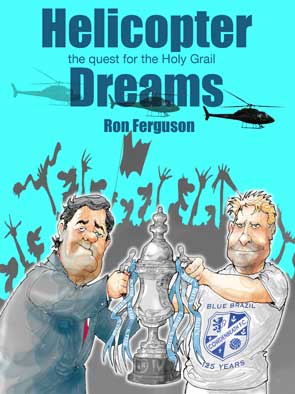
From the Bookshelf: Helicopter Dreams


Title: Helicopter Dreams
Author: Ron Ferguson
Publisher: Famedram Publishers
First published: 2006


Some thirteen seasons after his previous book on the plight of Cowdenbeath FC, Ron Ferguson’s Helicopter Dreams tells the story of Cowdenbeath’s Championship winning season of 2005/06.


Back in 1992/93, Ferguson intertwined the story of Cowdenbeath’s miserable season with the rich and largely ignored story of this maligned town in the Kingdom of Fife in Black Diamonds and the Blue Brazil. Having being prompted into reading BDBB by Daniel Gray, author of Stramash, I was taken aback by the warmth, wit and fantastic story that unfolded over every page. It is a book that will stand the test of time and should be required reading of all football fans, but especially those in Scotland – it tells the story of certain aspects of Scotland’s history than any mighty tome or historian ever could.


In that regard, Helicopter Dreams had a lot to live up to and sadly it was found wanting. Where BDBB was almost perfect in its balance between the history of the town and the football club, Helicopter Dreams suffers from having less historical material to draw from and the sadly, less interesting narrative (peculiarly, most sports books are better when the team is going through a crisis rather than a journey to the summit).


I was at Central Park on the final day of the season where Cowdenbeath defeated Elgin City 2-1 to clinch the Third Division Championship and there is no doubt it was a historic moment in the club’s history – grown men were weeping, the pitch was invaded and there was a sense of jubilation in the air, but Ferguson, who so mastered his narrative structure in BDBB lets the reader down by using messages from forums and then having supporters describe the final day of the season. It sadly becomes repetitive and makes the size of the achievement, a once in a generation championship winning team, seem dull. The book could also do without the final third – a Question and Answer section with the players, manager Mixu Paatelainen, chairman, backroom staff and fans – fashioned into a narrative and having such unfettered access Ferguson, who is capable of elegant prose, could have made this very interesting but sadly it came across to this reader as ‘bonus chapters’ rather than enhancing the first section of Helicopter Dreams.


However, readers should not feel Helicopter Dreams is a waste of your time – it very much is not, but in comparison to his previous piece of work, Ferguson hasn’t made Helicopter Dreams as readable as his 1990s classic.


Buy Helicopter Dreams here.